Entradas

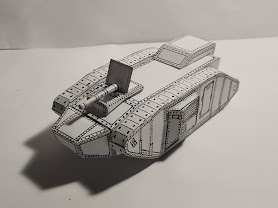
Char 2C (French Super Heavy Tank) Papercraft

Imagen
History: The Char 2C, also known as the FCM 2C, is a French heavy tank, later also seen as a super-heavy tank, developed during World War I but not deployed until after the war. It was, in total volume or physical dimensions, the largest operational tank ever made. Designed at the end of the Great War to replace the Saint-Chamond tank and participate in the main offensives planned for 1919, this super heavy and heavily armed tank had to be able to cross trenches of 5.20 m, - the width of a lock in the north channel of France - and crush enemy checkpoints without the support of artillery. Faced with the technical and industrial problems of this program too ambitious for the capabilities of a French industrial-military complex already committed to the maximum of its capabilities, General Jean Estienne ordered, in January 1918, no less than 700 of these "land battleships" . intended for assault artillery. Only ten were finally built by the Forges et Chantiers de la Méditerrané...
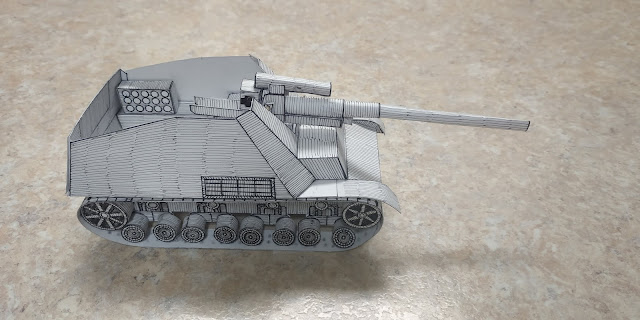
Papercraft - Building Sd.Kfz. 165 Hummel (German Self-propelled Artillery)

Imagen
History: Hummel (German: "bumblebee") was a self-propelled gun based on the Geschützwagen III/IV chassis and armed with a 15 cm howitzer. It was used by the German Wehrmacht during the Second World War from early 1943 until the end of the war. Its ordnance inventory designation was Sd.Kfz 165. This vehicle arose from the need to provide artillery support to armored units such as the Panzer Divisions, but without making the division lose mobility. Based on the chassis of the Panzer IV, the mobile turret was replaced by a fixed structure where an artillery gun was housed. Initially they were mounted with a 105mm cannon to finally go on to mount a 150mm sFH 18M cannon with 18 rounds. The Hummels were delivered to the heavy batteries of the Panzer Divisions' armored artillery detachments in early 1943, first entering action at the Battle of Kursk. Subsequently ammunition transports were assigned to the division. More than 500 units of this vehicle were built. 3D Model: XXXgau...

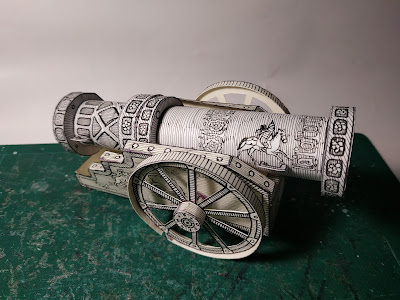
The Great Bombard or Dardanelles Gun (Ottoman Heavy Artillery)

Imagen
History: Was a 15th-century siege cannon, specifically a super-sized bombard, which saw action in the 1807 Dardanelles operation.  It was built in 1464 by Turkish military engineer Munir Ali and modelled after the Orban bombard that was used for the Ottoman besiegers of Constantinople in 1453. Such super-sized bombards had been employed in Ottoman warfare and in Western European siege warfare since the beginning of the 15th century. According to Paul Hammer and Gábor Ágoston, the technology could have been introduced from other Islamic countries which had earlier used cannons. The Ottoman army successfully deployed large bombards at the siege of Salonica in 1430, and against the Hexamilion wall at the Isthmus of Corinth in 1446. At the siege of Constantinople in 1453, the Ottomans employed a number of cannons, anywhere from 12 to 62. They were built at foundries that employed Turkish cannon founders and technicians, most notably Saruca,...

The League of the Gentlemen Extraordinary - The Phantom's Tank Bank Breaker Papercraft

Imagen
History: The League of the Gentlemen Extraordinary is a film based on the comic written by Alan Moore and illustrated by Kevin O'Neill , about a Victorian version of the Justice League but with characters from 19th century literature. Of which are: Allan Quatermain, protagonist of "The Mines of King Solomon" by H.R. Haggard. Mina Murray, from Bram Stoker's novel "Dracula" Captain Nemo, from Jules Verne's "20,000 Leagues Under the Sea" Dr. Jekyll / Edward Hyde, from "The Strange Case of Dr. Jekyll and Mr. Hyde" by Robert Louis Stevenson Hawley Griffin (Skinner in the movie), "The Invisible Man" by H.G. Wells As well as the insertion of new characters for the film such as: Dorian Gray, from Oscar Wilde's novel "The Picture of Dorian Gray" Tom Sawyer, from "The Adventures of Tom Sawyer" by Mark Twain. Although the film was a tremendous failure in both criticism and collection and was the last film in ...