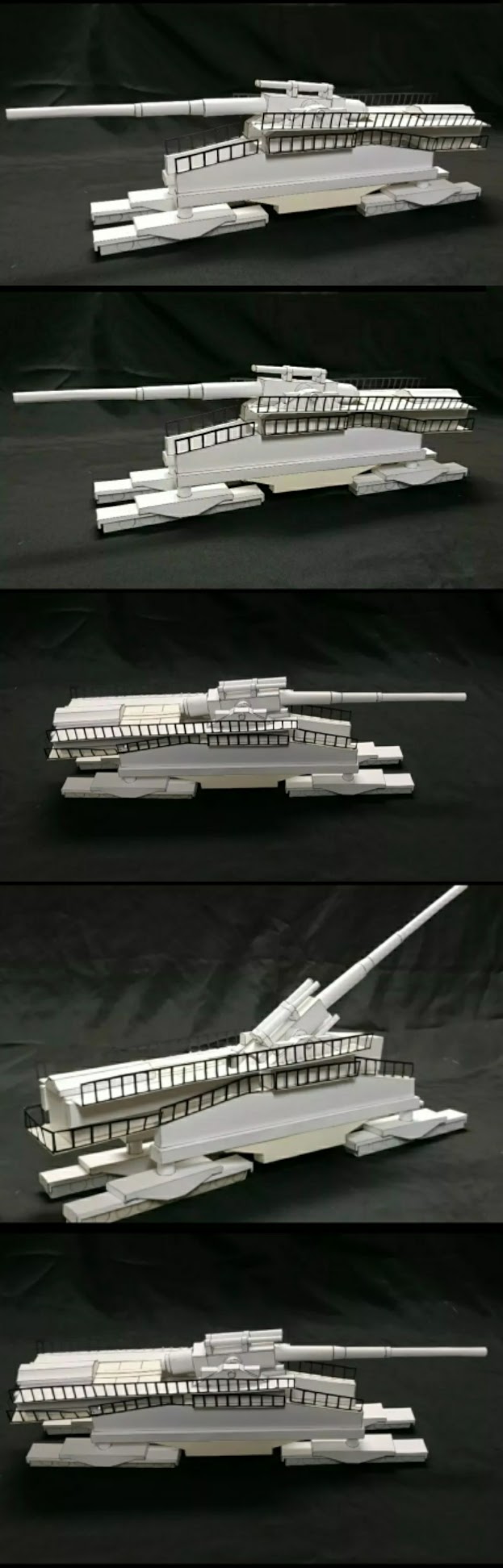
Dicker Max (German Self Propelled Gun)

The Dicker Max was a German heavy tank destroyer and self-propelled gun developed during World War II. Its official name was 10.5 cm K gepanzerte Selbstfahrlafette, although it was nicknamed "Dicker Max," meaning "Fat Max." The vehicle was based on the Panzer IV tank chassis and mounted a powerful 105 mm K18 gun. Only two prototypes were built between 1940 and 1941, making it more of an experimental project than a mass-production vehicle. Its dimensions were large for the time: it weighed around 22 tons, had armor ranging from 10 to 50 mm thick, and reached a top speed of approximately 27 km/h.
The design of the Dicker Max was commissioned by the German high command to the Krupp company in 1939. The vehicle's original purpose was to destroy heavy fortifications, especially the bunkers of the French Maginot Line. Therefore, the German army requested a mobile vehicle equipped with a large-caliber gun capable of destroying fortified defenses at long range. However, by the time the prototypes were completed in 1941, the French campaign had already ended, so the vehicle lost its initial mission and was reassigned as a heavy tank destroyer on the Eastern Front.
In terms of its military performance, the Dicker Max stood out for the enormous power of its 105 mm gun, capable of destroying heavily armored Soviet tanks at long ranges. Furthermore, it possessed excellent gun depression, allowing it to fire from elevated and concealed positions. However, it also had several significant weaknesses: its armor was relatively thin, the top of the fighting compartment was open, and it had poor mobility in difficult terrain. These characteristics made it vulnerable to attacks from enemy artillery, infantry, and fast tanks.
The Dicker Max saw action primarily on the Eastern Front during the German invasion of the Soviet Union in 1941. The two prototypes were assigned to the 521st Heavy Anti-Tank Battalion (Schwere Panzerjäger-Abteilung 521). During the initial campaigns of Operation Barbarossa, the vehicle was used to destroy Soviet tanks and defensive positions. One of the prototypes was lost to fire in June 1941, while the second remained in service until approximately 1943. Although its numbers were extremely limited, the vehicle demonstrated that heavy guns mounted on armored chassis could be effective as tank destroyers.
Despite not being mass-produced, the Dicker Max had a significant influence on the development of future German tank destroyers. Its experience helped the German army better understand the advantages and disadvantages of vehicles with large-caliber guns mounted on tank chassis. Later models, such as the Nashorn and the Jagdpanther, continued the idea of combining high firepower with tactical mobility. Today, the Dicker Max is remembered as one of the most unusual and iconic prototypes of German military engineering from World War II.
Buy here
$7.00
Before making the purchase, please notify me on social media such as Facebook, Twitter, Instagram, Bluesky or Deviantart


Comentarios
Publicar un comentario