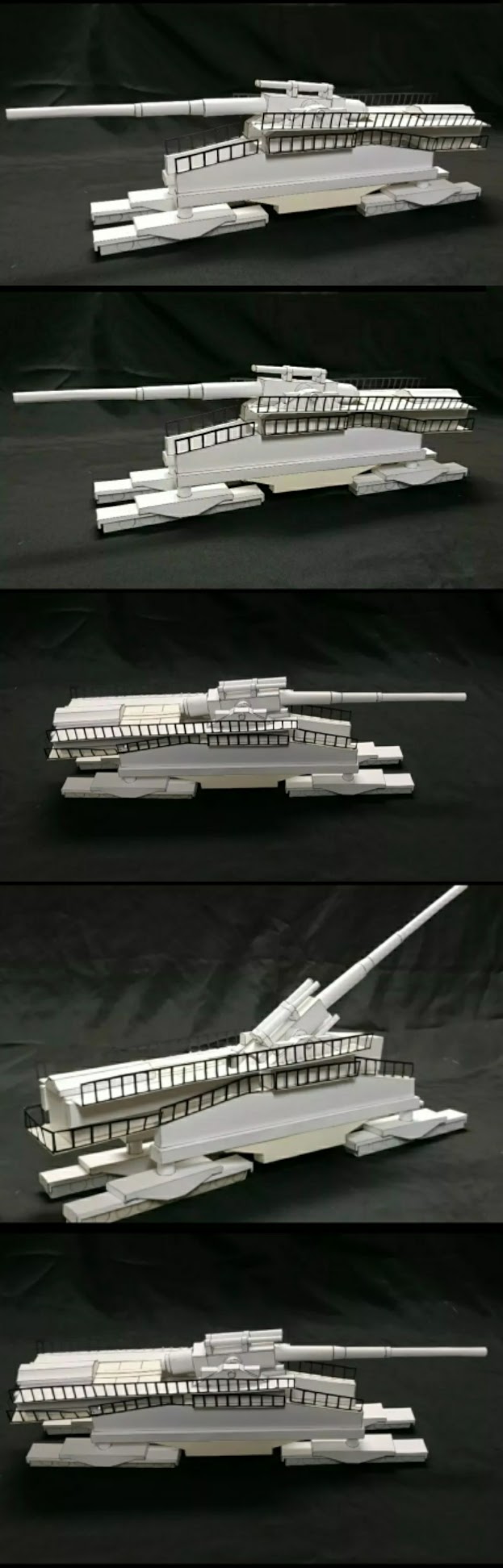
Su-14 (Soviet Propelled-Gun)

The idea arose within the context of the Soviet doctrine of deep operations, which required weapons capable of destroying enemy fortifications, machine gun nests, and artillery positions at long range. Soviet commanders sought a weapon capable of supporting mechanized forces.
The project formally began in 1933 under the supervision of Soviet engineer Pavel Nikolayevich Syachintov, one of the leading specialists in self-propelled combat vehicles of the time.
Development was carried out at Plant No. 185 in Leningrad, one of the main Soviet facilities dedicated to the design of experimental armored vehicles. The only prototypes of the vehicle were built there. The SU-14 was conceived as part of the self-propelled heavy artillery program known as "Triplex TAON," intended to deliver high-powered fire against strategic targets and enemy fortifications.
Initially, a platform derived from the Soviet T-28 medium tank was chosen, although during testing it was found that many of its components could not adequately support the vehicle's enormous weight. Due to these problems, it was decided to incorporate numerous components from the T-35 heavy tank, which had a more robust suspension and transmission.
The first prototype was completed in 1934 and immediately began a series of mobility and firing tests. The firing trials were satisfactory, but mechanical problems quickly emerged. The vehicle weighed approximately 48 tons in its initial configurations, an extraordinary figure for a self-propelled vehicle of the time.
Its crew consisted of seven to eight men, including a driver, commander, gunners, and loaders. The engine used was an M-17 with approximately 680 horsepower, which allowed the enormous vehicle to reach speeds of between 22 and 25 kilometers per hour.
The suspension employed coil springs and various reinforced components to support the weight of the main gun and ammunition.
One of the most striking features of the SU-14 was its enormous open fighting compartment, from which the crew operated the main gun. The initially planned armament was the 203mm B-4 heavy howitzer, one of the most powerful artillery pieces available in the Soviet arsenal.
This howitzer could destroy concrete fortifications, defensive positions, and troop concentrations at long ranges. Later, experiments were conducted with mounting the 152mm B-30 naval gun, seeking to improve the vehicle's range and accuracy.
Tests were also carried out with the 152mm Br-2 gun, one of the Red Army's most advanced long-range weapons. As secondary armament, between two and four 7.62 mm DT machine guns were installed for close-range defense.
The original armor protection was relatively light, with frontal plates up to 20 mm thick and side plates between 6 and 10 mm thick.
This protection was sufficient against small arms fire, but left the vehicle vulnerable to anti-tank guns and enemy artillery. During testing, numerous mechanical defects were detected related to the transmission, suspension, and overall reliability of the system.
The second prototype, designated SU-14-1, incorporated significant improvements to the running gear and power plant. Despite these modifications, the 1936 tests revealed more than one hundred technical problems that hindered its adoption by the Red Army.
Another major drawback was the slow rate of fire. Some assessments indicated that it could take between five and seven minutes to complete a single roundConsequently, the Soviet military began to doubt the vehicle's operational viability. The situation worsened when the political purges of the late 1930s directly impacted the program.
Syachintov was arrested in 1936 and later executed, depriving the project of its main technical driving force. Without the support of its chief designer and with numerous outstanding technical problems, the program lost priority within Soviet industry.
In August 1938, the project was officially canceled, and plans for mass production were abandoned. Total SU-14 production was limited to just two prototypes: an SU-14 and an SU-14-1.
However, the vehicle's story did not end with the program's cancellation. During the Winter War against Finland, interest in these machines resurfaced.
In 1940, both prototypes were modified to act as fortification and bunker destroyers.
Additional armor was added, significantly increasing their frontal and side protection.
With these improvements, the frontal armor reached approximately 50 mm and the side armor up to 60 mm in some areas. Although the modifications were completed too late for participation in the Winter War, the vehicles remained available for future operations.
When Germany launched Operation Barbarossa, the two prototypes were mobilized for the defense of Moscow. Their combat participation was very limited, but it constituted one of the few occasions on which these experimental vehicles were used operationally.
After the Battle of Moscow, the concept was considered obsolete compared to more modern and practical designs of self-propelled artillery. One of the prototypes was finally scrapped in 1960, while the other survived and was preserved as a historical artifact.
The legacy of the SU-14 lies in its being one of the first Soviet attempts to create a powerful, self-propelled heavy artillery piece. Although it failed as a military project, its technical experiences influenced later developments that would culminate in successful vehicles such as the SU-152 and other self-propelled artillery pieces used by the Soviet Union during World War II and the postwar period.
$8.00
Buy here

Comentarios
Publicar un comentario